Loyalty Over Logic: The Cult Code of “He Can Do No Wrong”
When devotion outweighs evidence, reason becomes a casualty

Introduction: The Unbreakable Bond
It’s one of the most perplexing aspects of the Manson Family story. Long after the arrests. Long after the evidence. Long after the courtroom theatrics. Many of the young women who once called themselves Charlie’s “Family” still spoke about him with loyalty, even love.
To outsiders, this was unthinkable. He’d been accused of orchestrating brutal murders. He’d left a trail of manipulation, abuse, and psychological destruction. Why defend him? Why not denounce him the moment the blood was visible?
But that question assumes something that isn’t true: that cult devotion ends where evidence begins. In reality, the more evidence appears, the more entrenched the devotion often becomes.

How Loyalty Becomes the Highest Virtue
When Charles Manson gathered his Family in the late 1960s, he didn’t build a movement around religion or strict ideology. He built it around himself.
He offered a vision of freedom, of rejecting the “straight world,” of living authentically. He spoke to their pain, their alienation, their desire for a higher purpose. Then he slowly replaced their internal compasses with his own.
Manson used affection and affirmation as tools. His followers were told they were special. Chosen. Loved. But that love came with a condition: loyalty to Charlie above all.
And once loyalty became the measure of worth, logic had no foothold. To doubt Manson was to doubt the only person who, in their eyes, had ever truly seen them.
The Absence of Guilt: Charles Manson

Charles Manson never swung the knife himself. That, to him, was everything.
After the Crimes: Loyalty as Identity
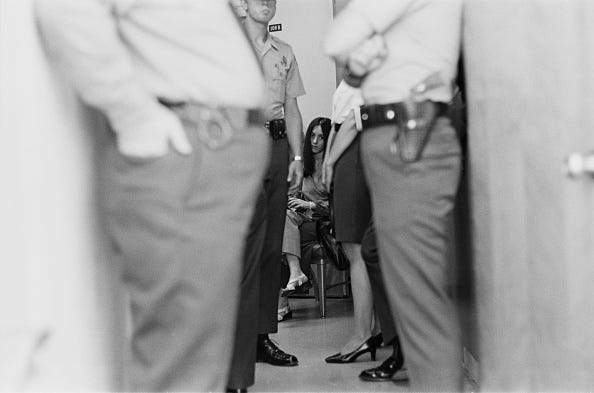
Even after the murders, many Family members refused to break ranks. Some shaved their heads in solidarity. Some carved Xs into their foreheads, in unison with Manson. They appeared at the courthouse like a living shield.
When Susan Atkins was arrested, she initially bragged about the killings to fellow inmates, echoing Charlie’s vision of an apocalyptic revolution. But later, when faced with the death penalty, she would still hesitate to disavow him. Leslie Van Houten, who by all accounts was the least hardened, said she believed “Charlie was a Christ-like leader” at the time (from Karlene Faith’s The Long Prison Journey of Leslie Van Houten).
This wasn’t about evidence. It was about identity. By then, to denounce him would be to destroy the self they had built around him.
The Spiral of Rationalization
Cult psychologists call this “escalating commitment.” Once you’ve invested your loyalty, time, and identity, the cost of leaving becomes unbearable. The more a leader is attacked, the more followers close ranks. External criticism feels like a personal attack.
Manson understood this intuitively. He told his Family they were soldiers in a coming race war, that outsiders were blind, that his enemies were theirs. This reframed every challenge to his authority as proof of his prophecy.
Sound familiar? It should. Because this dynamic is not unique to Spahn Ranch in 1969. It’s human. It can happen anywhere a leader merges their image with a cause and convinces followers that loyalty is virtue and doubt is treason.